Orchids of South Africa – A Field Guide.
door/by
Steve Johnson & Benny Bytebier – Foto’s/photography: Herbert Stärker.
2015, Struik Nature, Cape Town, South Africa.
ISBN (book) 978 1 77584 139 5
ISBN (E-pub) 978 1 77584 263 7
ISBN (PDF) 978 1 77584 262 0
536 pp., many colour pictures (at least 3 pro species!), one distribution map pro species.
536 pp., veel kleurenfoto’s (minstens 3 per soort), voor elke soort een distributiemap.
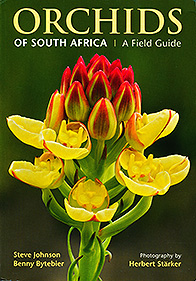
Een ‘Field Guide’ moet volgens mij een zo ruim publiek aanspreken en dus aan de gebruiker een korte maar heldere uitleg geven over het onderwerp van de gids: orchideeën van Zuid-Afrika.
Deze gids voldoet aan deze verwachting in de ‘Introduction’ (p. 6 tot 26) met een kort geschiedkundig overzicht van de Zuid-Afrikaanse orchideeën, de omgeving waar ze groeien, de floristieke regio’s, hun habitat, de orchideeënflora mét uitleg over het gebruik van wetenschappelijke namen, de structuur van orchideeën (wortels, stengels en bladeren, bloemen en zaden), de reproductiebiologie van orchideeën (met o.a. bloeiperiodes en meer specifiek voor Zuid-Afrikaanse orchideeën de invloed van branden op de bloei), het in stand houden van orchideeën en orchideeënpopulaties en een vooral voor de leek nuttig item over de bloemonderdelen van orchideeën. Al deze items zijn zeer mooi geïllustreerd.
Een tabel (p. 26) sluit de ‘Introduction’ af. Ze geeft een overzicht van de orchideeënsoorten (18) die wél in Zuid-Afrika gemeld zijn maar die sinds decennia niet meer gezien zijn of waarvan geen fotomateriaal kon gevonden worden.
Dan volgt uitleg over hoe de gids moet gebruikt worden (p. 27).
Een hoofdstuk ‘Orchid Genera of the Region’ (p. 28 tot 35) bespreekt kort elk in Zuid-Afrika voor komend orchideeëngeslacht. Een duidelijke foto vergezelt de tekst.
Het hoofdstuk ‘Orchid Species of the Region’ (p. 36 tot 522) bespreekt alfabetisch én kort 455 (van de 473) Zuid-Afrikaanse orchideeënsoorten. Per bladzijde wordt één soort behandeld: korte beschrijving van de plant en de bloemen en onderaan de bladzijde (boven een groene achtergrond) informatie over groeiplaats en bloeiperiode. Elke soort is geïllustreerd met minsten drie duidelijke foto’s: bloeiende plant, de bloemen en detailfoto(‘s) van de bloem(en). Een distributiemap toont in welke omgeving de planten groeien en bloeien.
Zes natuurhybriden worden illustratief voorgesteld op p. 523.
Men kan zich nu afvragen: “Al die soorten staan alfabetisch gerangschikt, moet ik dan het hele boek doorbladeren en elke foto bekijken om één orchidee te kunnen determineren?” Wel, een identificatiesleutel tot de in deze gids besproken geslachten biedt hulp om te bepalen binnen welk geslacht een bloeiende plant thuishoort en dan, ja dan moet er wel wat gebladerd worden om deze of gene soort te determineren. Ik hoop alleen maar dat zoals met vele botanische identificatiesleutels deze sleutel ook bruikbaar is voor iedere gebruiker en niet alleen maar door diegene die de sleutel gemaakt heeft. Van hier uit (België in Europa) is dat onmogelijk te testen.
Met een verklarende woordenlijst ‘Glossary’ (p. 528), een bibliografie ‘Further reading’ (p. 529) en een ‘Index’ (p. 530 tot 536) sluit deze ‘Field Guide’ af.
Besluit.
Deze gids is in de eerste plaats misschien wel bedoeld om aan een Zuid-Afrikaans publiek de Zuid-Afrikaanse orchideeën te leren kennen. Ik hoop dus dat de gids in Zuid-Afrika op een grote schaal zal verspreid worden omdat ‘kennis helpt in stand houden’.
Daarnaast is deze gids ook een zeer mooi fotografisch document waarvan elke natuurliefhebber die naar Zuid reist van op de hoogte moet (!) gebracht worden.
Voor liefhebbers van orchideeënboeken is dit boek zeker een mooie aanvulling van hun orchideeënbibliotheek.
Als ‘Field Guide’ (veldgids) is dit boek wat groot en zwaar om in een vestzak meegedragen te worden tijdens een excursie. Maar… al wie op stap gaat in de natuur draagt een rugzak met proviand, fotomateriaal, regenkledij. Bij dat allemaal is zeker nog plaats voor deze interessante ‘Field Guide’. Dus!
En ook: neemt men deze ‘Field Guide’ niet mee op excursie? Wel, neem dan veel foto’s en gebruik, eens weer thuis, de ‘Field Guide’ om de foto’s te determineren want daarvoor is deze gids ook meer dan geschikt.
Lees ook: The Cape Orchids (klik hier!)
top.
I think that a 'Field Guide' has to give the user a brief but clear explanation on the subject of the guide: orchids of South Africa.
This guide meets this expectation f.i. in the ‘Introduction’ (p. 6 to 26) with a brief historical overview of the South African orchids, the environment where they grow, the floristic regions, their habitat, the orchid flora with explanation on the scientific names, the structure of orchids (roots, stems and leaves, flowers and seeds), the reproductive biology of orchids (including flowering periods, specifically for South African orchids the impact of fires on the bloom), the conservation of orchids and orchid populations and especially a for the layman useful item on the flower parts of orchid flowers. All these items are very well illustrated.
A table (p. 26) closes the 'Introduction' and gives an overview of the orchid species (18) that were reported in South Africa but which have not been seen for decades nor that photographs could be traced.
Then follows an explanation on how the guide should be used (p. 27).
A chapter 'Orchid Genera of the Region’ (p. 28 to 35) briefly discusses each orchid genus in South Africa. A clear picture for each genus is accompanying the text.
The chapter 'Orchid Species of the Region’ (p. 36 to 522) briefly discusses alphabetically 455 (out of 473) South African orchid species. Per page one species is discussed: brief description of the plant and the flowers and at the bottom of the page (above a green background) information on habitat and flowering period. Each species is illustrated with at least three clear photos: flowering plants, flowers and detail(s) of the flower(s). A distribution map shows the environment in which the plants grow and flourish.
Six natural hybrids are illustratively represented on p. 523.
One may now ask: "All these species are arranged alphabetically, do I scroll through the whole book and view each picture to determine one orchid?" Well, an identification key to the in this guide discussed genera offers help to determine within what genus a flowering plant belongs and then, yes, then some scrolling has to be done to identify the species one is looking on. I only hope that, as is the case with many botanical identification keys, this key is also useful for any user and not only for the one who made the key. From here (Belgium in Europe) it is impossible to test that key.
With a Glossary (p. 528), a bibliography 'Further reading' (p. 529) and an Index (p. 530 to 536) the 'Field Guide' ends.
Conclusion.
This guide is perhaps primarily intended to teach the South African population about their South African orchids. So I hope that the guide will be distributed in South Africa on a large scale because ‘knowledge helps sustain, conservation’.
Additionally, this guide is also a very beautiful photographic document. Any nature lover who travels to Southern must be aware/be brought in touch with this ‘Field Guide’.
For collectioneurs of orchids books this interesting guide book is a great addition to their orchid library.
As 'Field Guide' this book is a bit big and heavy to be carried in a jack pocket during an excursion, but ... all those going out in nature are carrying a backpack with supplies, photographic materials, rainwear... With all of that stuff there is certainly still space for this interesting 'Field Guide' in the backpack. So!
And also: when one doesn’t take this 'Field Guide' on an excursion? Well, take lots of pictures and use, once back home, the 'Field Guide' to identify the pictures because for this purpose the guide is also more than useful.
Further reading: The Cape Orchids (click here!)
top.