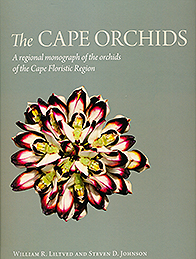
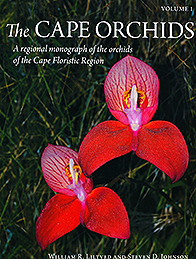
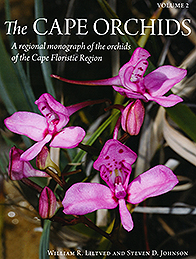
The Cape Orchids
A regional monograph of the orchids of the Cape Floristic Region.
Door/by William R. Liltved & Steven D. Johnson
A4+, 2 volumes, 19 + 1022 pp., a lot of colour photos,
Sandstone Editions, Noordhoek, Cape Town, South Afrika, 2012.
Standard edition ISBN 978-0-9870197-0-7
Collectors’ edition ISBN 978-0-9870197-3-8 (uitgebracht op slechts 50 exemplaren/only 50 copies have been produced)
Het boek is opgedragen aan Harry Bolus zaliger
(1834-1911),
de stichter van de orchideeënkunde/-kennis (orchidology)
in Zuid-Afrika.
This book is dedicated
to the memory of Harry Bolus (1834-1911),
founder of orchidology
in South Africa.
Extra reading
(incl. polination movie):
Disa forficaria
Interesting addendum:
click here!
De eerste 19 bladzijden, genummerd met Romeinse cijfers, geven wat wetenswaardigheden over het ontstaan van het boek, een werk van jaren. Zo was er in het begin van het project nog geen sprake van digitale fotografie. Er is in het kort wat uitleg over de legendes van de foto’s (hier labelling genoemd), de classificatie van de orchideeën in dit boek, herbarium collectienummers, enzovoort…
In ‘Introduction’ (p. 1-23) komen diverse onderwerpen aan bod die, mooi geïllustreerd, aan de lezer een goed inzicht van de Kaap Regio bieden: het landschap, de vegetatie, de geologie met ook aandacht voor fossiele planten en klimaatomstandigheden uit het verleden, de orchideeënflora, het in stand houden van de orchideeën en hun habitat maar ook over het verlies van habitat bijvoorbeeld als gevolg van te intense betreding door onder andere orchideeënliefhebbers, de rol van vuur in de evolutie van sommige habitat, genetische vervuiling ten gevolge van bijvoorbeeld pollinia die uit privécollecties ‘ontsnappen’ en zo hybriden doen ontstaan die in de natuur niet gewenst zijn, enzovoort… Het artikel ‘The conservation status of orchids in South Africa’ sluit dit inleidend hoofdstuk af.
Het eerste hoofdstuk ‘History of Botanical Exploration’ (p. 24-39) start met de Nederlandse periode (the Dutch period, 1652-1771) toen Paul Herman (1646-1695) onderweg naar Ceylon (nu Sri Lanka) de eerste herbariumspecimen collecteerde. Daarna kwamen de Zweden (1750-1800), waarvoor Carl Linnaeus orchideeën van de Kaap publiceerde in Plantae rariores africanae. De Engelsen kwamen uiteraard ook langs (1830-1850) en in die periode speelde Lindley zijn rol. Dan was er Harry Bolus (1874-1911) aan wie het tweede hoofdstuk ruimschoots aandacht schenkt. Vanaf p. 37 wordt de twintigste eeuw behandeld. Van 1901 tot 1950 werden 14 nieuwe soorten beschreven, 21 nieuwe soorten tussen 1951 en 2000. Pas na de oorlogen van de twintigste eeuw hernieuwde zich de interesse voor de orchideeën van de Kaap. Dit hoofdstuk is mooi geïllustreerd.
Hoofdstuk twee ‘Harry Bolus (1834-1911) - His life and Botanical Works’ (p.40-49) is helemaal aan Bolus gewijd.
Het derde hoofdstuk ‘Morphology of Orchids’ (p. 50-67) schenkt rijkelijk geïllustreerd uitvoerig aandacht aan alle onderdelen van orchideeënplanten en -bloemen.
‘Orchids and Fire’ (p. 68-73) behandelt een onderwerp dat door relatief weinig mensen, orchideeënliefhebbers inbegrepen, gekend is namelijk de positieve invloed, de noodzaak zelfs van vuur op de plantengroei en -bloei.
Hoofdstuk vijf ‘Pollination and Natural Hybridisation’ (p. 74-111) bespreekt de bestuiving door vlinders, nachtvlinders, vliegen, bijen (Melittidae uitgezonderd), oliën verzamelende bijen (Melittidae), kevers, vogels, aantrekkingskracht door middel van ‘valse beloften’ bij sommige soorten (Deception and mimicry), zelfbestuiving en natuurhybridisatie. Dit hoofdstuk is rijkelijk geïllustreerd, een aantal foto’s zijn werkelijk spectaculair.
Vanaf p. 112 tot en met p. 127 wordt de cultuur en kunstmatige hybridisatie besproken.
In het zevende hoofdstuk (Volume 1: p. 128-483; Volume 2: p. 485-895) worden per geslacht de in de Kaap Regio terrestrisch groeiende orchideeën uitgebreid besproken: Brachycorythis, Bartholina, Holothrix, Habenaria, Bonatea, Stenoglottis, Disperis, Brownlea, Pachites, de Coryciinae, Ceratandra, Evotella, Pterygodium, Corycium en Satyrium in Volume 1; Disa, Liparis, Eulophia, Acrolophia en Calanthe in Volume 2.
Dan komen in hoofdstuk acht de epifytisch groeiende soorten aan bod (Volume 2: p. 896-923): Polystachya, Angraecum, Cyrtorchis, Mystacidium en Tridactyle.
Vanaf p. 924 zijn er een aantal appendices: ‘Appendix A: Gallery of recent Cape orchid photographs’ (p. 924-957) met wondermooie foto’s; Appendix B: ‘References to Cape orchids in Bolus’s published werk (p. 958-964); Appendix C: ‘Fay Anderson’s Watercolours in The Cape Orchids’ (p. 965-967) met verwijzingen naar de bladzijden waar de aquarellen van Fay Anderson gepubliceerd zijn.
Vanaf p. 968 tot 971 vinden we een verklarende woordenlijst (Glossary of botanical terms).
De bladzijden 972 en 973 stellen ons de auteurs van dit boek voor, vanaf p. 974 tot 983 de medewerkers en productie team.
Een lijst van bedankingen en credits voor de foto’s: p. 984-985.
Een uitgebreide bibliografie (p. 986-1003) en een index van trefwoorden (p. 1004-1022) sluiten dit boek af.
Conclusie.
Toen ik in 2002 de mooie folder zag die dit boek aankondigde, dacht ik al: “Dat ziet er zeer goed uit. Als de kwaliteit van het boek op zijn minst wordt zoals de folder, zal het formidabel zijn.” Het heeft nog tien jaar geduurd eer het boek uiteindelijk geproduceerd is en op de markt verscheen. Het is een zeer groot boek (2 volumes) met veel inhoud geworden. Het boek is prachtig geproduceerd en is met zeer veel zeer mooie tot spectaculaire, soms bladzijdegrote foto’s en reproducties geïllustreerd. De bespreking van de soorten is uitgebreid en geeft zeer veel informatie.
Ik ben zeer onder de indruk.
Deze uitgave mag gerust als voorbeeld dienen voor andere publicaties over orchideeën want wie orchideeënboeken koopt wil én duidelijke uitleg en beschrijvingen mét daarnaast zeer bruikbare illustraties of dit nu foto’s zijn, tekeningen of reproducties. In dit boek krijg je dat allemaal.
Lees ook: Orchids of South Africa - A Field Guide (klik hier!)
The first 19 pages, with Roman numerals, give some information about the creating of the book, a work of years. So f.i. in the beginning of the project was it digital photography not in use yet. There is a brief explanation about the labeling of the pictures, the classification of the orchids in this book, herbarium collection numbers, etc ...
In the ‘Introduction’ (p. 1-23) various topics, beautifully illustrated, are mentioned in order to teach the reader about the Cape region: the landscape, vegetation, geology with attention to fossil plants and climatic conditions in the past, the orchid flora, the conservation of the orchids and their habitats but also the loss of habitat for example due to too intense habitat trampling by among others also orchid enthusiasts, the role of fire in the evolution of some habitats, genetic pollution caused by f.i. pollinia from private collections that 'escape' and so created hybrids that are not desirable in nature, and so on ... The article ‘The conservation status of orchids in South Africa’ closes this introduction.
The first chapter, ‘History of Botanical Exploration’ (p. 24-39) starts with the Dutch period (1652-1771) when Paul Herman (1646-1695) on his way to Ceylon (now Sri Lanka) collected the first herbarium specimen. Then came the Swedes (1750-1800), for which Carl Linnaeus published Cape orchids in ‘Plantae rariores Africanae’. The English, of course, passed by (1830-1850): during their time Lindley played his role. Then came Harry Bolus (1874-1911): the whole second chapter pays a lot of attention to him and his orchid work. From p. 37 the twentieth century is treated: between 1901 to 1950 14 new species were described, 21 new species from 1951 to 2000. Only after the wars of the twentieth century interest in the orchids of the Cape is renewed. This chapter is beautifully illustrated.
Chapter two ‘Harry Bolus (1834-1911) - His Life and Botanical Works’ (p.40-49) is devoted entirely to Bolus.
The third chapter, ‘Morphology of Orchids’ (p. 50-67) gives lavishly illustrated detail at all aspects of orchid plants and flowers.
‘Orchids and Fire’ (p. 68-73) deals with a topic that is known by relatively few people, orchid lovers included: the positive influence, even the necessity of fire on vegetation and flowering.
Chapter Five ‘Pollination and Natural Hybridization’ (pp. 74-111) discusses the pollination by butterflies, moths, flies, bees (Melittidae excluded), oil-collecting bees (Melittidae), beetles, birds, attraction through ‘false promises’ (Deception and mimicry) in some species, selfing and natural hybridization. This chapter is richly illustrated, some photos are truly spectacular.
The pages 112 to 127 discuss the culture and artificial hybridization.
In the seventh chapter (Volume 1: p. 128-483, Volume 2: p 485-895) the terrestrial orchid species in the Cape Region within the following genera are discussed in detail: Brachycorythis, Bartholina, Holothrix, Habenaria, Bonatea, Stenoglottis, Disperis, Brownlea, Pachites, the Coryciinae, Ceratandra, Evotella, Pterygodium, Corycium and Satyrium in Volume 1; Disa, Liparis, Eulophia, Acrolophia and Calanthe in Volume 2.
Then, in chapter eight, come the epiphytic growing species (Volume 2: p. 896-923) Polystachya, Angraecum, Cyrtorchis, Mystacidium and Tridactyle.
From p. 924 there are a number of appendices: ‘Appendix A: Gallery of recent Cape orchid photographs’ (p. 924-957) with wonderful photos; Appendix B: ‘References to Cape orchids in Bolus's published work’ (p. 958-964); Appendix C: ‘Fay Anderson's Watercolours in the Cape Orchids’ (p. 965-967) with references to the pages where the watercolors are published.
From p. 968 to 971 we find a glossary of botanical terms.
Pages 972 and 973 present the authors of this book, from p. 974 to 983 the cooperators and the production team.
A list of acknowledgments and credits for the photos: p. 984-985.
An extensive bibliography (p. 986-1003) and an index of key words (p. 1004-1022) close this book.
Conclusion.
In 2002, when I saw the beautiful flyer announcing this book, I thought: “This flyer looks very good. If the book has at least the same qualities as the folder, it will be formidable.” It took another ten years before the book was produced and appeared on the market. It is a very large (2 volumes) with a lot of content. The book is beautifully produced and is very nicely illustrated: quality pictures and reproductions. The discussion of the species is extensive and gives a lot of information.
I am very impressed.
This publication may well serve as an example for other publications on orchids because who wants to buy those publications is looking for clear explanations and descriptions with also very useful illustrations whether they are photographs, drawings or reproductions. In this book you get it all.
Further reading: Orchids of South Africa - A Field Guide (click here!)