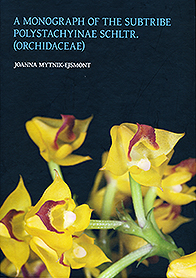
A Monograph of the Subtribe Polystachyinae Schltr. (Orchidaceae).
door/by Joanna Mytnik-Ejsmont
Fundatcja Rozwoju Uniwersutetu Gdańskiego, Polen, 2011.
Formaat A4
400p. met vele pentekeningen en verspreidingskaartjes + 22p. met 96 kleurenfoto’s/with many pen drawings and distribution maps + 22p. with 96 color photos
ISBN 978-83-7531-175-4
Link to more publications by this authors/andere publicaties van deze auteurs: click here!
nederlands - english
Het Departement of Plant Taxonomy and Nature Conservation van de Faculteit Biologie aan de Universiteit van Gdańsk heeft de laatste jaren onder leiding van Prof. Dr. Dariusz Szlachetko heel wat gepubliceerd over de Orchidaceae. Voor haar thesis bestudeerde Joanna Metnik-Ejsmont de Polystachyinae onder supervisie van Prof. Szlachetko, zelf auteur van heel wat publicaties waarvan we er op deze website reeds enkele besproken hebben.
Orchideeëngeslachten binnen de subtribus Polystachyinae worden in alle tropische en subtropische gebieden gevonden: Van zuidelijk Noord-Amerika, Zuid-Amerika, Zuidoost-Azië tot tropisch Afrika, Madagascar en de omliggende eilanden. Voor deze publicatie heeft de auteur 5480 herbariumspecimens in eenentwintig herbaria bestudeerd.
In de eerste drie hoofdstukken lezen we: een inleiding , de geschiedenis van de classificatie van de subtribus en de lagere taxa, de gebruikte materialen en methodes voor het tot stand komen van deze publicatie.
In hoofdstuk vier (p. 20-25) wordt de morfologie besproken: habitus en grootte van de plant, de stam, de bladeren, de bloemstengel, de bloemen (structuur en resupinatie), de stempelzuil en de vruchten en zaden. Ook micromorfologische en histochemische kenmerken worden besproken (zaadlobben, chromosoomgetallen en omvang van het genoom, de histochemische kenmerken, de geur van de bloemen).
In hoofdstuk vijf (p. 26-28) komt de ecologie aan bod alsook de biologie van de bloemen: de reproductieve biologie. De auteur behandelt ook de insectenlokkers:pseudopollinia en voedselhaartjes, de bestuivers en de bestuiving. Voedselhaartjes zijn één- tot viercellige haarachtige structuren die voedsel bevatten dat door insecten verzameld wordt. De pseudopollinia zijn meelachtig, geel en wat polliniavormig. Ze komen bij aanraking los van het lipoppervlak.
Hoofdstuk zes (p. 29-31) behandelt de verspreiding en hoofdstuk zeven (p.32-33) bespreekt de ‘conservation status’.
In hoofdstuk acht (p. 34-35) heeft de auteur het over hybridisatie en de niveaus van polyploïdie en in hoofdstuk negen (p. 36-37) geeft ze een antwoord op de vraag: “Wat is een genus? Taxonomistici versus cladistici.”
In hoofdstuk tien bespreekt ze samen met M. Górniak & M. Dudek de fylogenie van de Polystachyinae (p. 38-52).
Hoofdstuk elf (p. 53-55) biedt een synopsis van de Polystachyinae.
In hoofdstuk twaalf (p.56-360) behandelt ze de systematiek van de Polystachyinae. In dit hoofdstuk komen de volgende geslachten aan bod: Chelystachya, Neobenthamia, Neoburttia, Dendrobianthe, Isochilostachya, Polystachya in de beide Amerika’s (met Polystachya Baranow), Azië (met Polystachya Baranow), Afrika en Madagascar alsook de diverse secties van het geslacht Polystachya, Epiphorella, Unguiculabia, Disperanthoceros en Szlachetkoella. Hier wordt elk geslacht uitgebreid besproken. We krijgen een sleutel tot de soorten en elke soort wordt zeer uitgebreid besproken. Bij de bespreking van de meeste soorten wordt een pentekening en een distributiekaartje gepubliceerd.
Hoofdstuk dertien (p. 363) vermeldt een niet-aanvaarde naam: Polystachya coelogynochila Kraenzl. Deze soort werd beschreven op basis van uit twee soorten samengestelde specimen. Dit is uiteraard quatsch!
Het niet aanvaarden van twee geslachten binnen de Polystachyinae wordt in hoofdstuk 14 gemotiveerd. Het betreft de geslachten Imerinaea Schltr. en Herderorkis Thouars.
Deze monografie sluit af met een bibliografie (p. 365-373), een Appendix 1: Voucher information and GenBank accession numbers for samples used in the book (p. 374-378), een index van de wetenschappelijke namen (p. 379-386), een legende van de pentekeningen en de verspreidingskaartjes (p. 387-396) en een lijst met referenties van de kleurenfoto’s.
Naar mijn mening zijn orchideeënmonografieën en -flora héél belangrijke publicaties die voor iedereen die in orchideeën meer dan op het niveau van huis, tuin en keuken geïnteresseerd is. Deze monografie is dus ook zelfs al betreft het een ‘tak’ (subtribus) binnen de Orchidaceae, die bij mijn weten minder populair is, toch belangrijk. Is populariteit een belangrijk criterium? Ik dacht het niet.
The Department of Plant Taxonomy and Nature Conservation of the Faculty of Biology at the Gdansk University published in recent years a lot about the Orchidaceae under the promotion of Prof. Dr. Dariusz Szlachetko. For her thesis Joanna Metnik-Ejsmont studied the Polystachyinae under supervision of Prof. Szlachetko, himself the author of numerous publications, some we already reviewed on this website.
Orchid Genera within the subtribe Polystachyinae can be found in all tropical and subtropical regions: from southern North America, South America, Southeast Asia to tropical Africa, Madagascar and surrounding islands. For this publication, the author studied 5480 herbarium specimens in twenty herbaria.
In the first three chapters we read an introduction to the history of the classification of the subtribe and lower taxa, the materials and methods for the realization of this publication.
In chapter four (p. 20-25), the morphology is discussed: habitus and size of the plant, the stem, the leaves, the flower stalk, the flowers (structure and resupination), the column and the fruits and seeds. Also micro morphological and histochemical characteristics are discussed (cotyledons, chromosome numbers and size of the genome, the histochemical characteristics, the scent of the flowers).
In chapter five (p. 26-28), the ecology is discussed as well as the biology of flowers, the reproductive biology. The author also discusses the insect attractors in the flowers (pseudopollinia and food hairs), pollinators and pollination. Food hairs are hair like structures with one to four cells that contain food that is collected by insects. The pseudopollinia are mealy, yellow and have the form of pollinia: they lose the lip surface when touched by an insect.
Chapter six (p. 29-31) deals with the distribution and chapter seven (p. 32-33) discusses the 'conservation status'.
In chapter eight (p. 34-35), the author talks about the levels of hybridization and polyploidy and in chapter nine (p. 36-37) she gives an answer to the question: "What is a genus? Taxonomists vs. cladistics."
In chapter ten (p. 38-52), she discusses with M. & M. Dudek Górniak the phylogeny of Polystachyinae.
Chapter eleven (p. 53-55) provides a synopsis of the Polystachyinae.
In chapter twelve (p.56-360) she treats the system of Polystachyinae. This chapter covers the following genera: Chelystachya, Neobenthamia, Neoburttia, Dendrobianthe, Isochilostachya, Polystachya in the Americas (with Polystachya Baranow), Asia (Polystachya Baranow), Africa and Madagascar as well as the various sections of the genus Polystachya, Epiphorella, Unguiculabia, Disperanthoceros and Szlachetkoella. Each genus is discussed. We get a key to the species and each species is discussed very extensively. Beside the discussion of most species a pen drawing and a distribution map are published.
Chapter thirteen (p. 363) mentions a non-accepted name: Polystachya coelogynochila Kraenzl. This species has been described on the basis of two types of composite specimen. which is, of course, not done!
The ‘not accepting’ of two genera within the Polystachyinae is motivated in Chapter 14. These genera are Imerinaea Schltr. and Herderorkis Thouars.
This monograph concludes with a bibliography (p. 365-373), appendix 1: ‘Voucher information and GenBank Accession numbers for samples used in the book’ (p. 374-378), an index of scientific names (p. 379-386), a legend of the pen drawings and distribution maps (p. 387-396) and a list with references to the color photos.
In my opinion his orchid monographs and flora are very important publications for anyone interested in orchids on a higher level than ‘the home, garden and kitchen interest’. This monograph is therefore important, even if it is about a subtribe within the Orchidaceae which is, to my knowledge, less or not popular. Is popularity is an important criterion? Not at all.
top
More publications by this authors/andere publicaties van deze auteurs: click on title!
- Contributions to the orchid flora of Guinea, West Africa.
- Illustrated field guide to the Orchids of the Yotoco Forest Reserve (Colombia) (an).
- Materials to the Orchid flora of Colombia, volume 1.
- Materials to the Orchid flora of Colombia, volume 2.
- Materials to the Orchid flora of Colombia, volume 3.
- Orchidaceae of Tahiti, French Polynesia.
- Orchidaceae of West-Central Africa Vol. 1 & 2.
- Orchids of the Darien Gap.
- Orchids of the Valle del Cauca Vol. 1, 2, 3 & 4.