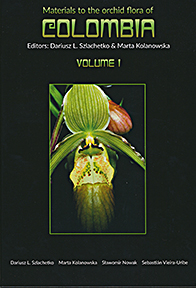
Materials to the Orchid flora of Colombia, volume 1.
door/by Szlachetko D.L., Kolanowska M., Nowak S. & Vieira-Uribe S.
ed. Szlachetko D.L. & Kolanowska M.
Koetlz Botanical Books, Oberreifenberg Germany, 2017 (click here!).
A4, 546 pp., veel pentekeningen/many pen drawings, 53 distribution maps, 122 kleurenfoto’s/color photos.
ISBN 978-3-946583-11-0
Link to more publications by this authors/andere publicaties van deze auteurs: click here!
Other books edited by Koeltz Koeltz orchid books.htm
Dit werk is opgedragen aan Rudolf Schlechter, een van de belangrijkste en invloedrijkste Duitse orchideeëntaxonomen van het begin van de twintigste eeuw.
Met al het materiaal dat de auteurs zowel in de natuur als in diverse herbaria onderzocht hebben, voorzien Szlachetko en Kolanowska in een uitgave van in het totaal 20 volumes over de orchideeënflora van Columbia. Ze zullen hun best doen 2 volumes per jaar uit te geven.
Hoofdstuk 1.
Na de gebruikelijke voorwoorden, inleidingen (p. 15-19) en wat uitleg over Rudolf Schlechter (p. 11-13 door Irene Bock, D.O.G.) lezen we in hoofdstuk 1, ‘General information’, wat algemene informatie (p. 21 -29): Study area, Biodiveristy, History of botanical studies in Colombia, Orchids in the Colombian flora, Material and methods, Nomenclature en Acknowledgements. De informaties in deze 9 bladzijden zijn én informatief en nuttig om weten. ‘Nomenclatuur’ vermeldt o.a. een belangrijk aantal nieuwe soorten en nieuwe combinaties evenals de lecotypificatie van enkel soorten.
Hoofdstuk 2.
Het hoofdstuk 2, ‘Taxonomic treatment’ (p. 31-444), is gebaseerd op de ‘Darwinian (evolutionary) classification’ waardoor een classificatie kan gebruikt worden die gebaseerd is op fylogenetische relaties én ook praktischer is in gebruik. Voor het concept van de ‘orde Orchidales’ volgen de auteurs Dahlgren & Rasmussen (1983) die drie families erkenden: de Apostasiaceae, de Cypripediaceae en de Orchidaceae. Er is een ‘natural’ sleutel tot de families en subfamilies binnen de Orchidales die in Colombia vertegenwoordigd zijn; twee sleutels tot de genera: een ‘natural’ en een ‘artificial’.
Hoofdstuk2, subhoofdstuk 1 (p.35-78) behandelt de Familie Cypripediaceae, tribus Selenipedieae en Phragmipedieae. Hierin komen aan bod:
Tribus Selenipedieae, subtribus Selenipediinae (p. 36-50) de genera:
Selenipedium garayanum, S. palmifolium, S. olgae, S; dodsonii, S. aequinoctiale, S. chica, S. chica ssp. chica en S. chica ssp. buenaventurae. Van S. dodsonii wordt vermoed dat deze soort uit Ecuador ook in Colombia voorkomt.
Er zijn pentekeningen van de gynostemiumstructuur van Selenipedium, vergelijkende pentekeningen van de dorsale sepalen en synsepala, petalen, lippen, staminodia en bladeren van diverse Selenipedium-soorten. Er is een vergelijkende tabel voor de soorten S. chica, S. garayanum en S. olgae.
Bij het subhoofdstuk over de subtribus Selenipediinae wordt een sleutel gepubliceerd tot de orchideeën genera met een rietvormige stam. In dit volume komen daarvan volgende genera aan bod: Selenipedium, Tropidia en Corymborkis.
Tribus Phragmipedieae (p. 51-78), subtribus Phragmipediinae, Phragmipedium subgenera Micropetalum, Phragmipedium. In het totaal komen 20 Phragmipedium-soorten aan bod.
Hoofdstuk2, subhoofdstuk 2 (p. 78-444) behandelt de Familie Orchidaceae. Hierin komen aanbod:
De soorten binnen de Subfamilie Orchidoideae met de tribus Orchideae, subtribus Habenariinae genera Habenella, Habenaria, Phinorchis, Kusibabella en Bertauxia.
De soorten binnen de Subfamilie Tropidioideae genera Corymborkis en Tropidia.
De soorten binnen de Subfamilie Spiranthoideae met de tribus Goodyereae, subtribus Goodyerinae genera Microchilus, Platythelis, Ligeophila, Aspidogyne en Kreodanthus.
De in dit hoofdstuk 2 besproken soorten zijn rijkelijk met pentekeningen geïllustreerd. Van elke soort is naast de naam ook de auteur en de referentie van de publicatie vermeld. Deze is gevolgd door een synoniemenlijst, de beschrijving van de plant en de bloemen, de ecologie (terrestrisch/epifytisch… en habitat), de verspreiding en de representatieve/onderzochte specimen, ander onderzocht materiaal en waar nodig relevante nota’s.
Op het einde van het boek vinden we een uitgebreide bibliografie (p. 445-451), een index van de wetenschappelijk namen in dit volume (p. 453-462), een index van de in dit volume geciteerde collecties (p. 463-473), een lijst van in dit volume geciteerde publicaties en hun in de tekst gebruikte afkortingen (p. 475-480), distributiekaarten (p. 483- 509) en 122 goede tot zeer goede kleurenfoto’s van representatieve soorten.
Conclusie.
Dit is het eerste van 20 te verwachten volumes over de orchideeën in Colombia. De auteurs hadden om een of andere reden geen toegang tot alle herbaria in Colombia, noch tot alle materiaal dat buiten Colombia gedeponeerd is en dus, zoals één van de auteurs, Dariusz L. Szlachetko, schrijft onder de hoofding ‘In lieu of an introduction’: “Gezien dit geen volledige orchideeënflora is voor dit land hebben we ons werk ‘Materials tot he Orchid Flora of Colombia’ genoemd in plaats van ‘The Orchid Flora of Colombia’.
Hoe dan ook zal dit werk, eens alle volumes gepubliceerd zijn, lange tijd niet overtroffen worden en zal het dat fameuze masterpiece ‘Venezuelan Orchids Illustrated 1-6 (1959-1976) van Dunsterville en Garay zeker overtreffen.
Al wie in Zuid-Amerikaanse orchideeën geïnteresseerd is, zal zeker al in dit eerste volume zijn gading vinden en zeker en vast ook, zonder twijfel, in de nog volgende volumes.
Ik kijk alvast uit naar die volgende volumes.
top
This work is dedicated to Rudolf Schlechter, one of the most important and influential German orchid taxonomists of the beginning of the twentieth century. With all the material that the authors have studied, both in nature and in various herbaria, Szlachetko and Kolanowska present the first volume of a total of 20 volumes about the orchid flora of Columbia. They will do their best to edit 2 volumes per year.
Chapter 1.
After the usual prefaces, introductions (pages 15-19) and some explanation about Rudolf Schlechter (pages 11-13 by Irene Bock, D.O.G.) we read in chapter 1, 'General information' (pages 21-29): Study area, Biodiveristy, History of botanical studies in Colombia, Orchids in the Colombian flora, Material and methods, Nomenclature and Acknowledgments. The information in this 9 pages is both informative and useful to know. 'Nomenclature' mentions, among other things, an important number of new species and new combinations as well as lecotypifications of some species.
Chapter 2.
Chapter 2, 'Taxonomic treatment' (pp. 31-444), is based on the 'Darwinian (evolutionary) classification, which allows to propose a classification based on phylogenetic relations, but at the same time it is more practical (cit.). For the concept 'order Orchidales' the authors follow Dahlgren & Rasmussen (1983), who recognized three families: the Apostasiaceae (Asiatic), the Cypripediaceae and the Orchidaceae. There is a 'natural' key to the families and subfamilies within the Orchidales that are represented in Colombia; two keys to the genera: a 'natural' one and an 'artificial' one (p.32-34).
Chapter 2, subchapter 1 (pp.35-78) deals with the Family Cypripediaceae, tribe Selenipedieae and Phragmipedieae. Here are discussed:
Tribus Selenipedieae, subtribus Selenipediinae (pp. 36-50) the genera:
Selenipedium garayanum, S. palmifolium, S. olgae, S. dodsonii, S. aequinoctiale, S. chica, S. chica ssp. chica and S. chica ssp. buenaventurae. S. dodsonii from Ecuador possibly also occurs in Colombia.
There are pen drawings of the gynostemium structure of Selenipedium, comparative pen drawings of the dorsal sepals and synsepala, petals, lips, staminodia and leaves of various Selenipedium-species. There is a comparative table for the species S. chica, S. garayanum and S. olgae.
In the subchapter about the subtribus Selenipediinae a key is published to the genera with a reed-like stem. In this volume the following orchid genera with such a habit are discussed: Selenipedium, Tropidia and Corymborkis.
Tribus Phragmipedieae (pp. 51-78), subtribus Phragmipediinae, Phragmipedium subgenera Micropetalum, Phragmipedium: a total of 20 Phragmipedium-species are discussed.
Chapter 2, subchapter 2 (pp. 78-444) deals with the Family Orchidaceae. Here are discussed:
The species within the Subfamily Orchidoideae, tribus Orchideae, subtribus Habenariinae the genera Habenella, Habenaria, Phinorchis, Kusibabella and Bertauxia.
The species within the Subfamily Tropidioideae the genera Corymborkis and Tropidia.
The species within the subfamily Spiranthoideae, tribus Goodyereae, subtribus Goodyerinae the genera Microchilus, Platythelis, Ligeophila, Aspidogyne and Kreodanthus.
The species discussed in this chapter 2 are richly illustrated with pen drawings. In addition to the name of each species, the author and the reference to the publication are mentioned. This is followed by a synonym list, the description of the plant and the flowers, the ecology (terrestrial/epiphytic… and habitat), the distribution and the representative/examined specimen, other researched material and, where necessary, relevant notes.
At the end of the book we find an extensive bibliography (pp. 445-451), an index of the scientific names in this volume (pp.453-462), an index of the collections cited in this volume (p.463-). 473), a list of publications cited in this volume and their abbreviations used in the text (pages 475-480), distribution maps (pp. 483-509) and 122 good to very good color photographs of representative species.
Conclusion.
This is the first of 20 expected volumes about the orchids in Colombia. The authors did not manage to reach all the herbaria in Colombia, nor all the material deposited outside Colombia and by consequence as one of the authors, Dariusz L. Szlachetko, writes under the heading 'In lieu of an introduction': "Since it is not a complete orchid flora of this country, we decided to name our work 'Materials to the Orchid Flora of Colombia' instead of 'The Orchid Flora of Colombia' (cit.)”. In any case, once all volumes will have been published, this work will be unbeaten for a long time and it will certainly surpass that famous masterpiece 'Venezuelan Orchids Illustrated 1-6’ (1959-1976) by Dunsterville and Garay.
Anyone interested in South American orchids will certainly find something in this first volume and certainly also, undoubtedly, in those following volumes.
I am looking forward to the next volumes.
Bespreking volume 2: klik hier!
Bespreking volume 3: klik hier!
More publications by this authors/andere publicaties van deze auteurs: click on title!
- Contributions to the orchid flora of Guinea, West Africa.
- Illustrated field guide to the Orchids of the Yotoco Forest Reserve (Colombia) (an).
- Monograph of the subtribe Polystachyinae Schltr. (Orchidaceae) (a).
- Orchidaceae of Tahiti, French Polynesia.
- Orchidaceae of West-Central Africa Vol. 1, 2 & 3.
- Orchids of the Darien Gap.
- Orchids of the Valle del Cauca Vol. 1, 2, 3 & 4.