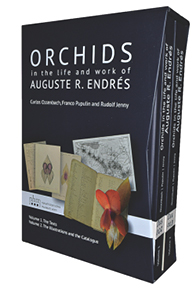
Orchids in the life and work of Auguste R. Endrés.
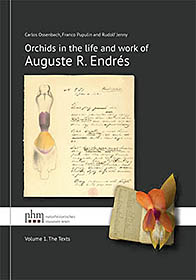
Vol. 1. The Texts (met veel illustraties/with many illustrations
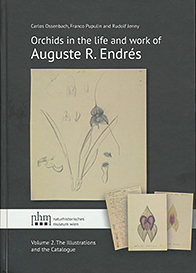
Vol. 2. The Illustrations and the Catalogue (met/with 387 pp. illustations)
door/by Ossenbach C., Pupulin F. & Jenny R.
Format 27,5 × 19,5 cm, 2 volumes in een cassette, harde kaft, 4 kg.
2013 - Verlag des Naturhistorischen Museums Wien;
ISBN 978-3-902421-77-7 2; €350.
Volume I.
This volumes has 8 chapters beside a Contents Foreword, Acknowledgements and an introduction.
With his statement in the foreword Carlyle A. Luer writes where this book is about: “Who was Endrés? Who was this man who could recognize unknown genera and species? All of us, whoever worked with orchids of Costa Rica, new the name, but nothing about the man except that this mysterious, hired collector had corresponded with Reichenbach, to whom most of his numerous collections had been sent. We are familiar with his name, because species had been named for him… Who was this man who preferred little, unpopular orchids instead of big, showy orchids? …”
Chapter 1: ‘Auguste R. Endrés (1838-1874) – His life’ by Carlos Ossenbach (p. 1 – 81) tells about his life from his birth in Herbitzheim –Elzas (now France); his migration in 1855 to America to live with his grandfather where he developed intensely his interest for horticulture and botany and came in contact with Captain Dow and Isaac Buchanan, an important orchid enthusiast, who would be important in Auguste Endrés’ life; his first journey to collect plants in Central America; his days in Costa Rica to collect orchids till his death at 36 years of age in 1874 in Colombia. When he was in Europe during his last year of life he met Reichenbach end Roelz. Reichenbach wrote about him: “… Endrés admired the plants the smaller their flowers were, and, to be candid, he had no appreciation of the demand of European amateurs till he returned lately to Europe…” As known, following Reichenbach’s will all his herbarium, botanical libray, instrument, collections of seeds, etc… ware donated to the Imperial Hof Museum in Vienna under condition that during 25 years after his death no access could be possible for exhibition, research, … By consequence Endrés’ materials (drawings, specimen, …) could not be studied as Endrés sent most of his materials to Reichenbach.
Chapter 2: ‘Orchid collecting in that rich coast’ by Carlos Ossenbach and Franco Pupulin (p. 83 – 119).
Subchapters give information about Costa Rican physical geography, climate and weather, vegetation and the orchid itineraries of Endrés in Costa Rica and Panama. Reichenbach described Endrés: “… he had not only an exceptional eye for rare plant novelties, but that he also had a sixth sense for knowing exactly where to travel during his collecting journeys, always choosing the country’s richest regions…”
An Appendix with this chapter give ‘Endrés collecting localities’.
Chapter 3: ‘Endrés the botanist’ by Franco Pupulin (p. 121 – 181).
Franco Pupulin writes: “It is no exaggeration to say that Endrés was the most proficient and dedicated botanist who visited Costa Rica during the nineteenth century. If one looks at the wordk he carried out in less than seven years of botanical exploration of the country, the results of his contribution are probalbly unequaled by any other researcher who ever studied the flora of Costa Rica.”
Subchapters inform about Endrés’ formation in botany; Cultural influences (he was in origin German speaking btu he wrote in English as this was by far the language of horticulture); A botanical model (the important mostly illustrated publications from the end of the 18th century and the 19th century probably were models for his botanical drawings); Endrés at work (How did Endrés work?); Costa Rican orchidology; Endrés’ book (Where is the book? At the end of this subchapter as homage to Endrés an impression is given of what this book could have been with drawings and texts by Endrés: imprssionant!).
Chapter 4: ‘Endrés as an illustrator by Franco Pupulin’ (p. 183 – 218).
Since ‘The golden age of botanical illustration in Europe’ there has been an interesting evolution in illustrating plants and flowers ‘From woodcut to copper’ over lithography to ‘Scientific orchid illustration today’. About ‘Endrés’ microscope’ Pupulin writes that: “… there is no doubt that he (Endrés) needed a solid instrument he could transport by mule on long trips, in order to do at least some illustrations in the field.” ‘Endres’ own style explains how Endrés worked to what resulted in his own style. The flower details in his drawings were precise and with a very high fidelity, as Pupulin writes: “… simply amazing…” and also: “But… Endrés was in Costa Rica to do something totally new.”
Chapter 5: ‘The human context: important figures in Endrés’ life’ by Carlos Ossenbach and Rudolf Jenny (p.219 – 254).
The authors stipulate here 2 major points: Endrés constantly was dependent from others solve his everlasting lack of finances and his ability to move in select circles of politician, scientists, businessman or wealthy farmers in Costa Rica or prominent scientists in botany in Germany, England and the United States… To name only some of them: James Bateman, Isaac Buchanan, John Day, John M. Dow, Johan Wolfgang von Goethe, Joseph Dalton Hooker, John Lindley, Heinrich Gustav Reichenbach, Harry James Veitch…
Chapter 6: ‘Endrés’ legacy at the Reichenbach Herbarium, Natural History Museum in Vienna’ by Ernst Vitek. (p. 255 – 277).
Above I wrote about Reichenbach’s will. His herbarium was brought to Vienna by train in four (yes 4!) large railwagons. The boxes were sealed till May 6th 1914. The Reichenbach herbarium that was composed by four parts must be arranged and mounted before giving access to researchers or visitors.
Endrés collected exclusively allover in Costa Rica. In the Reichenbach Herbarium this represents 2815 sheets, drawings included with among this 172 type sheets with drawings. From p. 264 on a table with the names of collectors, botanic gardens, orchid growers and the provenance of the plants.
Chapter 7: ‘ On Endrés’ traces: the Department Archives of the History of Science at the Natural History Museum in Vienna’ by Christa Riedl-Dorn (p. 279 – 303).
In this chapter the author writes about Reichenbach (this is not at all a repetition of wat is written in the former chapters): Who was Heinrich Gustav Reichenbach?; The testament; Auguste R. Endrés Bequest (papers by Endrés); The stock of manuscripts (by Endrés); Letters from Endrés to Reichenbach filius.
Chapter 8: ‘Species Endresianae’ by Franco Pupulin, Carlos Ossenbach, Rudolf Jenny and Ernst Vitek (p. 305 – 343).
Here we find a catlogue of all orchid types based on collections by Endrés associated with his drawings and other material from his collections.
To name only 2 of them: Barkeria lindleyana var. centerae Rchb.f. was sent from Costa Rica to Reichenbach in 1873 by Reichenbach; Chondrorhyncha endresii Schltr. was described by Schlechter to honor Endrés made a drawing and wrote a description of the details; etc… In total 114 species, 2 new genera and 2 varieties.
The remarkable amount information in these chapters bring us a lot of knowledge of the man who was amply known He worked under often terrible circumstances.
The first Volume of this publication end swith ‘Credits of illustrations’ (p. 345 -346) and a bibliography (p. 347 – 354).
Volume II.
In this volumes has 407 illustrations on 375 pages with a selection of Endrés’ drawings. It is the intention to give an as complete as possible impression of the astonishing diversity of orchid species studied and illustrated by Endrés and also to show the different types and stages of sketches prepared by him.
‘Laeliinae orchids’ (p. 1 - 56); Maxillariinae orchids (p.57 – 90); Oncidiinae orchids (p. 91 – 146); Pleurothallidinae orchids (p. 147 – 304); Stanhopeinae orchids (p. 305 – 318); Zygopetalinae orchids (p. 319 – 354); Other epiphytic orchids (p. 355 – 381);Terrestrial orchids (383 – 391).
‘The Catalogue’ (p.397 – 530) by Franco Pupulin, Carlos Ossenbach, Rudolf Jenny and Ernst Vitek is a long list of species names with references to the Reichenbach Herbarium (Rchb Herb), to the Vienna Archives (W), to Endrés’ notes, to illustrations by Endrés, to sheets with herbarium specimen, to sheet with a description of a species and to the date and locality. An ‘Appendix’ (p. 530 – 533) refers to Endrés’ materials at the Oakes Ames Orchid Herbarium at the Harvard University.
An ‘index (genera locator) completes this volume.
Conclusion.
I am impressed by this very informative volume 1 of this edition and by the gigantic amount of Endrés’ drawings and the catalog. For me this is one of the best and nicest edited orchid related books I have seen. I’m sure this 2 volumes edition will be of interest for orchid people who need/like to know more not only about orchids and of course orchidology.
Note.
Carlos Ossenbach from Costa Rica is a specialist in the orchidology of the Centra- and South American orchids. He wrote several artikels and books about this subject (for an exemple: click here!).
Franco Pupulin is Professor botanic at the University of Costa Rica, where he, as taxonoom, works in cooperation with the Lankester Botanical Garden. He also works at the Oakes-Ames-Herbarium at the Harvard Universität (USA). Pupulin is specialised in the orchid flora of Cast Rica. He wrote a lot of articles and books about this.
Rudolf Jenny is scientific cooperator at the Jany-Renz-Herbarium der Universität Basel. He is a specialist in the Taxonomie and Pollination ecologie of the Stanhopeinae en Catasetinae. Hij published several articles and also Monografies about the orchid genera Stanhopea (click here!) en Gongora. He owns the most complete private orchid library worldwide and runs the website ‘BibliOrchidea’ with access to free references to orchid literature. He is author of the very interesting editions‚ ‘… of men and orchids‘ (click here!).
Ernst Vitek works at the herbarium of the Natuurhistorisches Museum Wien.
Christa Riedl-Dorn works at the archives of the Natuurhistorisches Museum Wien.