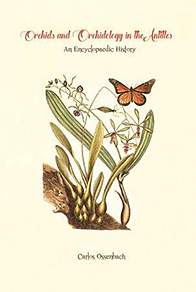
Orchids and Orchidology in the Antilles.
An Encyclopedic History.
By/door Carlos Ossenbach.
Koeltz Botanical Books, Oberreifenberg, Germany, 2016.
ISBN 978-3-946583-01-1,
Format A4+ (30.5 × 22.0 cm), xxi, 723 pp., many illustrations in color and black and white, numerous tables, hard - bound.
In English.
Available at Koeltz Botanical Books, 228.00 Euro, ca.US$ 270.00.
Koeltz: click here!
Other books edited by Koeltz Koeltz orchid books.htm
Dit boek is een vervolg op 'Orchids and Orchidology in Central America: 500 years of history' door Carlos Ossenbach in Lankesteriana 9, 1-268 (2009). Je kan dit online lezen: click here!
Ossenbach draagt dit volumineus werk op aan Etienne Marie Denise en Mercedes Naute, twee van zijn voorouders. Denise was een selfmade botanicus en horticulturist (1785-1861) die de ‘Flore d’Amérique’ (Parijs, 1843) publiceerde, een in die tijd zeer gewaardeerde uitgave. Mercedes Naute was Ossenbachs grootmoeder en Denises achterkleindochter.
Ossenbach informeert ons in 6 belangrijke, informatieve delen over de Antillen, een uitgestrekte regio waarvoor verschillende Europese landen imperialistische/kolonialistische interesse vertoonden, uiteraard ver van vredevol: chronologisch van de ontdekking door Columbus in 1492, wat het begin is van de genoteerde geschiedenis van de Caraïbische regio; over de evolutie van de botanische wetenschappen; over de beperkte kennis van orchideeën bij de lokale volkeren vóór de Spaanse veroveringen; de evolutie toen de Europese botanici de epifytische groei nog niet begrepen: “… bomen met takken in diverse vormen en dat allemaal vanuit één stam…” (zoals La Casas beschreef in zijn ‘General History of the Indies – hoofdstuk XLII, Masia: 223); het niet binominaal beschrijven van planten in de tijden vóór Linnaeus; de evolutie van de kennis over orchideeën en de beschrijving van de orchideeën van de Antillen; horticultuur; …
Part I: From the Spanish conquest to Carolus Linnaeus (p. 9 – 114) met ook enkele inleidende bladzijden waarop de geschiedenis, de geografie, de geologie, het klimaat, het milieu, de biodiversiteit en de orchideeëndiversiteit aan bod komen.
Part II: From the Age of Reason to Spain’s ‘Ominous Decade’ (p. 115 – 243).
Part III: The Golden Age of Antillean Orchidology (p. 245 – 299).
Part IV: The ‘Imperial Era’ (p. 301 – 435).
Part V: From war to war: 1914 – 1945 (p. 437 – 513).
Part VI: The second half of th XXth Century and the new Millenium (p. 515 - 606).
Alle 6 delen hebben subhoofdstukken waarin Ossenbach biografieën meegeeft van individuen, instituten en daarnaast beschrijft hij ook belangrijke historische feiten die de orchidologie in die regio beïnvloed hebben.
Dit encyclopedisch boek, wat de auteurs bedoeling was, toont duidelijk de historische, culturele, horticulturele en economische evolutie van de Antillen gedurende 5 eeuwen; de betrokken Europese staten met hun koningen of keizers; de wetenschappers en horticulturisten die in de Antilliaanse flora geïnteresseerd waren; de evolutie van de wetenschappelijke kennis van planten en van de orchidologie die verschilt van deze van Centraal- en Zuid-Amerika waar meer commercieel attractieve orchideeën groeien; …
In zijn introductie schrijft Ossenbach: “… dit werk is geëvolueerd tot een moeilijke hybride tussen een traditionele historische vertelling en een encyclopedisch woordenboek van personen en biografieën…” en hij hoopt ondertussen “… dat dit werk zowel waardevol zal zijn als ‘Historie’ en als ‘Encycopedie’…”
Het is een feit: dit boek informeert vanaf de periode Columbus (1492) tot 2015, onze moderne tijden: kolonisatie, mensen, botanie, horticultuur, … Eveneens een bewijs van deze ‘moeilijke hybride’ is de tabel van 63 bladzijden waarin chronologisch (Appendix I – Timeline) de belangrijkste documenten van meer dan 600 auteurs uit de periode 1640 – 2015 opgelijst zijn (p. 609 – 672). Een 44 bladzijden lange bibliografie vermeld de bronnen die Ossenbach consulteerde en bestudeerde voor dit boek (p. 677 – 721).
Op het einde van dit boek vinden we een Appendix II: ‘The Antillean Islands and regions in the names of their orchids’ (p. 673 – 676), Acknowledgments vervolledigen het boek.
Conclusie.
Dit boek biedt een zeer interessant inzicht in de Antillen, de orchidologie voor deze regio en de betrokken personen gedurende vijf eeuwen. The vele illustraties zijn van zeer goede kwaliteit maar ik begrijp niet waarom de legendes bij de ‘antieke’ illustraties onderaan boven die illustraties gedrukt zijn. Dat is jammer. Omdat de bron van die illustraties ook niet altijd duidelijk is, zou een index van die illustraties nuttig geweest zijn ook al omdat de meeste daarvan nooit eerder gezien zijn en mogelijk zijn ze ook niet online te vinden. Misschien zijn er een aantal online te vinden via plantillustrations.org: click here!
Dit boek hoort zeker thuis in de orchideeënbibliotheek van zij die meer willen weten en begrijpen dan alleen maar de ‘gewone’ orchideeëninformatie.
This book continues 'Orchids and Orchidology in Central America: 500 years of history' by Carlos Ossenbach in Lankesteriana 9, 1-268 (2009). To read this online: click here!
Ossenbach dedicates this voluminous work to Etienne Marie Denise and to Mercedes Naute, two of his ancestors. Denise was a self-taught botanist and horticulturist (1785-1861) who published ‘Flore d’Amérique’ (Paris, 1843) one in those days very appreciated publication. Mercedes Naute was Ossenbach’s grandmother and Denise’s great-granddaughter.
Ossenbach informs us in 6 major, very informative parts about the Antilles, a huge region where several European countries showed their imperial/colonist interest, of course far from peacefully: Chronological from the landing of Columbus in 1492, which is the beginning of the recorded history of the Caribbean region; about the evolution of botanical science; the limited knowledge about orchids by indigenous Antillean people before the Spanish conquest; the evolution in times where European botanists did not understand the habit of epiphytes: “…trees with branches in many different manner, all from one trunk or stem…’ (as La Casas wrote in ‘General History of the Indies – chapter XLII, Masia: 223); the not binominal description of plants before Linnaeus; the evolution of knowledge about orchids in general and the descriptions of Antillean orchids; horticulture; …
Part I: From the Spanish conquest to Carolus Linnaeus (p. 9 – 114) with also some introductory pages on history, geography, geology, climate, environment, biodiversity and Antillean orchid diversity.
Part II: From the Age of Reason to Spain’s ‘Ominous Decade’ (p. 115 – 243).
Part III: The Golden Age of Antillean Orchidology (p. 245 – 299).
Part IV: The ‘Imperial Era’ (p. 301 – 435).
Part V: From war to war: 1914 – 1945 (p. 437 – 513).
Part VI: The second half of th XXth Century and the new Millenium (p. 515 - 606).
Each of the six Parts has subchapters under which Ossenbach writes biographies of individuals, institutions and besides he gives important historical facts that influenced the orchidology in the region.
This encyclopedic book, as was the authors intention, clearly shows chronically the historical, cultural, horticultural and economic evolution during five centuries in the Antilles; the involved European states, their kings or emperors; scientists and horticulturists interested in the Antillean flora; the evolution in plant science and orchidology wich is different from orchidology of Central and South America where more commercial attractive orchids live; …
In his introduction Ossenbach writes that “…this work has become a difficult hybrid between a traditional historical narration and an encyclopedic dictionary of persons and biographies…” while he hopes that “…this work will live up to both ‘History’ and Encyclopedia...".
The fact is that this books informs from the Columbus times till 2015, our modern times: colonialism, people, botany, horticulture, ... Also an evidence of that ‘difficult hybrid’ is a table of 63 pages listing chronologically (Appendix I - Timeline) the most important documents by more than 600 authors from 1640 to 2015 (p. 609 – 672). The most important sources consulted and studied by Ossenbach are published in a 44 p. long bibliography (p. 677 – 721).
This book ends with an Appendix II: ‘The Antilleans islands and regions in the names of their orchids’ (p. 673 – 676) and Acknowledgments complete the book.
Conclusion.
This book gives a very interesting insight in the history of the Antilles, the Orchidology for this region and the involved people during 5 centuries. The many illustrations are of high quality but I cannot understand why the legends are published above a part, at the bottom part of the ‘antique’ illustrations. This is a pity. As it is not always very clear where those illustrations came from, an index to those antiquities would have been useful as many have never been seen and might not been online. Maybe one can find them via plantillustrations.org: click here!
This book is a must have in the orchid library of all orchid people who need to know and understand more than 'just the usual' orchid information.