Wild Orchids of Peninsular Malaysia.
door/by Ong P.T., O’Byrne P., Yong W.S.Y. and Saw L.G.
ed. Kiew R., Sharp I., Chung R.C.K. & Chua L.S.L.
publ. Forest Research Institute Malaysia (FRIM) & Ministry of Natural Resources and Environment Malaysia, Kepong – Selangor Darul Ehsan.
2011 (re-ed. 2015).
196 pp.,Zeer veel kleurenfoto’s/many color pictures.
ISBN: 978-967-5221-66-8
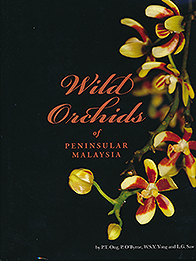
Dat in Maleisië 905 orchideeënsoorten binnen 143 orchideeëngeslachten groeien, leren we in de introductie maar ook dat ongeveer 20 procent van alle Maleisische orchideeën endemisch zijn. Er zijn ook de volgende alinea’s: ‘Recording for Posteriority’ heeft het kort over de geschiedenis van het beschrijven van de Maleisische orchideeën; ‘Extraordinary Diversity’ gaat over de enorme diversiteit van orchideeën: wortels, leefwijze, met of zonder bladeren, bloemen; ‘Dangerous Passion’ benadert de fascinatie die mensen hebben voor orchideeën; ‘More than just a Pretty Face’ gaat over orchideeën die voor consumptie gekweekt of verzameld worden maar ook voor het maken van kruisingen; ‘Orchids in Commerce’ toont met een fotocompositie een waaier van voor de handel gekweekte orchideeën.
Het hoofdstuk ‘A Kaleidoscope of Forms’ (p. 16- 31) geeft rijkelijk geïllustreerd een overzicht van de enorme diversiteit van orchideeën met aandacht voor de voor- en nadelen van epifytisch leven in ‘The Pros and Cons of Being an Epiphyte’, monopodiale of sympodiale groeiwijze in ‘The Dividing Line’, de soorten of types van wortels in ‘The Roots’, de vormendiversiteit van orchideeënbladeren in ‘The Leaves’ en de redenen voor die vormendiversiteit in ‘Different Strokes for Different Folks’, de bloemen in ‘The Sum of its Parts’, de bestuiving in ‘The Pollinator Quest’, de vruchtzetting in ‘The Fruit’ en ‘The seeds’.
‘Blooms of Many Parts’ (p.32-47) toont de diverse habitat en de invloed op de floristieke diversiteit.
‘It’s all about Seks’ (p. 48-59) toont en beschrijft rijkelijk geïllustreerd de bestuiving.
In het hoofdstuk ‘Ticking all the Boxes’ (p. 61-165) komt de classificatie aan bod met een overzicht van de subfamilies, geslachten en het aantal soorten onder ‘Orchid Subfamilies, Genera and Number of Species’. Deze worden voorgesteld aan de hand van mooie illustraties: Apostasioideae, Vanilloideae, Cypripedioideae, Orchidoideae, Epidendroideae. De illustraties spreken voor zich, er is dus weinig tekst.
Of alle Maleisische soorten voorgesteld of afgebeeld zijn, weet ik niet. Ik heb het niet geteld maar het zijn er in elk geval veel en voldoende toch om een goed idee te geven van het orchideeënpatrimonium van Maleisië.
‘In the Lab’ (p. 166-183) heeft het over de rol en het belang van wetenschappelijk onderzoek en het in stand houden van orchideeën in Maleisië met items als ‘The Role of the Forest Research Institue Malaysia’, ‘At the Hub: The Herbarium’, enzovoort…
Het boek sluit af met een hoofdstuk ‘Winners or Losers?’ waarin het belang van lokale orchideeënverenigingen aangehaald wordt, met een uitgebreide bibliografie ‘Furhter Reading’, bedankingen: ‘Acknowledgements’, een index en de auteurs worden kort voorgesteld.
Conclusie.
Dit boek geeft op een eigenzinnige wijze een impressie van het Maleisische orchideeënpatrimonium. Er is een overvloed aan zeer mooie foto’s, de teksten zijn beperkt gehouden maar wel informatief. Dit is een ongewoon en mooi orchideeënboek dat veel orchideeënliefhebbers zal boeien, zeker als kijkboek. Daarom mag het wat mij betreft gerust een ‘koffietafelboek’ genoemd worden.
We read in the introduction that Malaysia is home of 905 species in 143 orchid genera of orchids but also that about 20 percent of all Malaysian orchids are endemic. The paragraph ‘Recording for Posteriority' is briefly about the history of describing the Malaysian orchids; 'Extraordinary Diversity' is about the enormous diversity of orchids: roots, life style, with or without leaves, flowers; 'Dangerous Passion' tells about the fascination that people have for orchids; ‘More than just a Pretty Face’ informs shortly about orchids grown or harvested for consumption but also for making hybrids; ‘Orchids in Commerce’ shows a photo composition with a range of commercially cultivated orchids.
The chapter ‘A Kaleidoscope of Forms (p. 16- 31) gives a richly illustrated overview of the enormous diversity of orchids with focus on the pros and cons of epiphytic life in "The Pros and Cons of Being an Epiphyte', monopodial or sympodial habit in ‘The Dividing Line’, the types of roots in 'The roots', form diversity of orchids leaves in ‘The leaves’ and the reasons for their diversity of forms in ‘Different Strokes for Different Folks’, flowers ‘The Sum of its Parts’, pollination in ‘The Pollinator Quest, fruiting in 'The Fruit' and 'The seeds'.
'Blooms of Many Parts’ (p.32-47) shows the diversity of habitat and effect on the floristic diversity.
‘It's all about sex’ (p. 48-59) shows richly illustrated and describes pollination.
The chapter ‘Ticking all the Boxes’ (p. 61-165) is about the classification with an overview of the subfamilies, genera and the number of species: ‘Orchid Subfamilies, Genera and Number of Species’. These are presented with beautiful illustrations: Apostasioideae, Vanilloideae, Cypripedioideae, Orchidoideae, Epidendroideae. The illustrations speak for themselves, so there is not much text. If all Malaysian species are represented or portrayed? I do not know. I have not counted but there are at least much portrayed and yet enough to give a good idea about the orchid heritage of Malaysia.
‘In the Lab’ (p. 166-183) talks about the role and importance of scientific research and the preservation of orchids in Malaysia with items such as ‘The Role of the Forest Research Institue Malaysia', 'At the Hub: The Herbarium’, etc ...
The book concludes with a chapter ‘Winners or Losers?’ highlighting the importance of local orchid societies is cited, with an extensive bibliography ‘Furhter Reading’, 'Acknowledgements', an index and the authors are briefly presented.
Conclusion.
This book provides in an unique way an impression of the Malaysian orchid heritage. There are plenty of very nice pictures, texts are kept limited but informative. This is a unusual orchid book that will captivate many orchid enthusiasts, especially as picture book. Therefore it should, in my opinion, rightly be called a coffee table book.