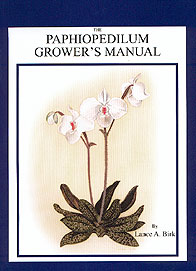
The Paphiopedilum Grower’s Manual
Second edition – Revised
Door/by
Lance A. Birk
2004, Pisang Press, California, USA
284 pp.
230 kleurenfoto’s/colour pictures
32 zwart-wit foto’s/black-white pictures
ISBN 9612826-1-4
Dit boek werd geschreven met de bedoeling aan de geïnteresseerden
één werk aan te bieden waarin zowel de soorten beschreven
zijn (identificatiemogelijkheid) als advies gegeven wordt hoe de soorten
te kweken. De auteur gaat uit van zijn ervaringen in de jungle, de habitat
van de diverse soorten, waar hij leerde hoe de planten in de natuur
groeien.
Eerst krijgen we de gebruikelijke inleidingen en introducties te lezen.
Er is een ‘glossary’ een tekening om de bloemdelen en de
bladvormen te beschrijven. In het hoofdstuk ‘Time for Change’
geeft de auteur een persoonlijke visie weer over het verleden, het heden
en de toekomst van de botanica. In sommige punten zullen de botanici
hem zeker kunnen volgen, in andere niet… Denk ik. In dit hoofdstuk
wordt de Royal Horticultural Society, the officiële ‘registrar’
van orchideeënhybriden, met argumenten als oorzaak van chaos aan
gewezen. Als die argumenten kans maken is wel de vraag.
Deel I van dit boek (p. 28 tot en met p. 138) behandelt de Paphiopedilum species die in cultuur zijn. Van elke soort is er minstens een kleurenfoto
en als die beschikbaar waren ook foto’s van het habitat waarin
de soorten voor komen.
Van elke soort wordt volgende informatie gegeven:
- De naam van de soort met auteur.
- De ondersoort (subgenus).
- De naam van de ontdekker of de persoon die de soort in cultuur bracht.
- De variëteiten.
- De vorm, de bladrand en de top van het blad alsook het vlakkenpatroon
op het blad.
- Gegevens over de onderkant van het blad.
- De grootte van de plant.
- De habitus van de plant.
- De temperatuurszone en lichtintensiteit waarin de soort groeit.
- De bloeiperiode.
- Waaraan moet voldaan worden opdat een soort zou bloeien.
- De verspreiding.
- De habitat en het klimaat van de habitat.
- Commentaren in verband met cultuur.
Op het einde van deel I is er een alfabetische soortenlijst gepubliceerd.
Deel II bespreekt de auteur de ‘basics’ van de Paphiopedilum-cultuur.
Hij baseert zich hier op zijn jarenlange (20 jaar) ervaring als Paphiopedilum-kweker
en ervaringen van collega’s kwekers. De auteur raadt aan dit deel
meerdere keren te lezen en te herlezen
Een eerste hoofdstuk, met kleurenillustraties, behandelt uitgebreid
(p. 141 tot en met p. 154) de ziekten, insecten en plagen die bij de
cultuur van Paphiopedilum-soorten kunnen opduiken.
Het tweede hoofdstuk (p. 155 tot en met p. 161) handelt over het water
geven (wanneer, hoe, voeding, waterkwaliteit, …).
Het derde hoofdstuk (p. 163 tot en met p. 167) gaat over lucht en licht,
de correcte balans. Een belangrijk punt is hier: “Het ontbreken
van adequate luchtcirculatie is dé oorzaak van het kapot gaan
van meer orchideeën dan bijna om het even welke andere factor.”
Een vierde hoofdstuk over scheuren en verpotten is met zwart-wit foto’s
geïllustreerd (p. 169 tot en met p. 175).
Een vijfde hoofdstuk behandelt de potmengsels (p. 177 tot en met p.
185).
Het zesde hoofdstuk bespreekt het verzorgen en opkweken van ‘in
vitro’ zaailingen (p. 187 tot en met p. 191).
In hoofdstuk zeven leren we planten op de vensterbank kweken (p. 193
tot en met p. 198).
Hoofdstuk acht gaat over het kweken van Paphiopedilum-soorten
in een gecontroleerde omgeving - bijvoorbeeld een serre (p. 199 tot
en met p. 205).
Al deze hoofdstukken geven heel wat nuttige en bruikbare informatie.
Deel III geeft bijkomende, nuttige informatie die niet direct met de cultuur te maken heeft zoals bijvoorbeeld het kruisen van orchideeën, het zaaien van orchideeën, het belang van orchideeënverenigingen, het fotograferen, het importeren van orchideeën, … (p. 208 tot en met p. 281). Daarbij zijn de hoofdstukken over ‘Het verzamelen van planten in de natuur’ (vooral toekomstige reizigers zullen de gegeven info nuttig vinden), de ‘Verdwijnende wouden’ en ‘Om over na te denken: een blauwdruk voor de uitroeiing van orchideeën’ (waarbij CITES over de rekel gehaald wordt) het lezen meer dan waard.
Dit boek zal mij vooral bijblijven als een enorm vat vol bruikbare
informatie voor de Paphiopedilum-kweker.
(top)
This book has been written for the purpose of satisfying the curiosity
of those growers in need of a single source giving them information
for identify and grow their Paphiopedilum-plants. The authors
bases his work on his personal explorations into the jungle habitats
where he learned how plants grow there.
On the first hand we read the usual prefaces and introductions, a glossary
is given and a drawing describing the flower parts and the shapes of
leaves. The author gives in a chapter ‘Time for a Change’
his personal view about the past, present times and future of the botanica.
In some point botanici will follow him, in others not… I think.
In this chapter, the Royal Horticultural Society, the official registrar
of orchid hybrids, is accused - with arguments - to be the origin of
chaos within the world of orchid hybrids. I do not know if this arguments
will have a chance.
Part I of this book (p. 28 till p. 138) gives information about the Paphiopedilum species in culture. From every species at least
one colour picture is printed and where available one picture of the
habitat in which the species lives.
From each species we find the following data:
- Name and author of the species.
- Subgenus.
- The name of the one who introduced the species.
- The varieties.
- Leaf shape, leaf tip, leaf margin, leaf markings and leaf underside
are described shortly.
- Plant size and habit, stem habit.
- Temperature zone and light intensity.
- Blooming period and blooming requirements.
- Range.
- Habitat and climate of the habitat.
- Comments about culture.
At the end of part one we find an alphabetic species list.
In part II the author gives us the ‘basics’ of Paphiopedilum-culture
based upon 20 years of experience of his own cultivation as well as
experiences gained from many other Paphiopedilum-amateurs.
He advises to read this part several times, again and again…
A first chapter, with colour illustrations, goes about plant diseases,
insects and pests (p. 141 till p. 154) that appear in Paphiopedilum-culture.
In the second chapter we learn about water (when to water, fertilizer,
quality, …) (p. 155 till p. 161).
The 3° chapter is about: Air and Light - the Correct Balance. An
important point: The lack of adequate air movement is responsible for
the dead of more orchids than almost any other factor (p. 163 till p.
167).
In the 4° chapter we learn about dividing and repotting. This chapter
is illustrated with black-white colour pictures (p. 169 till p. 175).
The 5° chapter goes about potting media (p. 177 till p. 185).
In the 6° chapter we read about seedling care from flask (p. 187
till p. 191).
Chapter 7 explains us how to grow ‘Orchids in the Home’
(p. 193 till p. 198).
Chapter 8 is about housing the orchids outdoors (in controlled conditions,
f.i. greenhouses) (p. 199 till p. 205).
All this chapters give a lot of interesting and useful information.
Part III deals with some non-growing aspects of raising orchids as
there are: Making a cross, seed sowing and replating, the importance
of orchid societies, photographing orchids, importing orchids, …
(p. 208 till p. 281). Chapters about orchid collecting in habitat (interesting
especial for people travelling to orchid habitats), disappearing forests
and ‘Matter over Mind, A Blueprint for Orchid Extinction’
(where CITES is questioned a lot) need more than ones attention.
This book will stay in my mind as an enormous source of information
for the Paphiopedilum-grower.
(top)