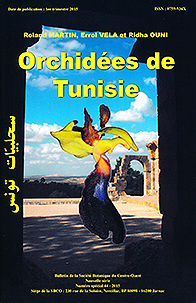
Orchidées de Tunisie
by/door/ par Roland Martin, Errol Vela and Ridha Ouni.
Bulletin de la Société Botanique du Centre-Ouest (France) – Numéro spécial 44, 2015.
In het Frans/in French/en Français.
160 richly illustrated pages/rijkelijk geïllustreerde pagina’s/pages richement illustrées.
ISSN 0759-934X
nederlands - english -français
Na de ‘Préface’ (Inleiding) (p. 12 & 13) door Édouard Le Floc’h (Le Floc’h is een van de co-auteurs van een aantal belangrijke publicaties over de flora van Tunesië) en een introductie door Yves Peytoureau, Président de la SBCO, vinden we de ‘Sommaire’ (Index).
Een subhoofdstuk ‘Origine du projet’ (start van het project) informeert over waarom voor Tunesië en de orchideeën gekozen werd beantwoorden de drie auteurs (één van hen is daar geboren).
Het subhoofdstuk ‘Zone étudiée’ (De bestudeerde zone) (p. 14 & 15) vermeld kort de bestudeerde zones.
In het hoofdstuk ‘Le contexte naturel’ (de habitat) (p. 17 tot 30) bespreekt met foto’s en geografische kaarten de habitat van de bestudeerde zone.
In het hoofdstuk ‘Des orchidées’ (de orchideeën) (p. 31 tot 37) komen enkele orchidologische aspecten aan bod waarvan de belangijkste misschien wel zijn de geschiedenis van de orchideeënkunde in Tunesië, uitleg over het waarom en hoe van de cartografie, …
In het hoofdstuk ‘Monographies’ (p. 39 tot 145) worden na een korte uitleg over taxonomie en nomenclatuur de in Tunesië voorkomende orchideeënsoorten alfabetisch per geslacht besproken: Anacamptis, Cephalanthera, Dactylorhiza, Gennaria, Himantoglossum, Limodorum, Neottia, Ophrys, Orchis, Platanthera, Serapias en Spiranthes. Van elke besproken soort worden een of een aantal synoniemen weergeven naast een korte commentaar betreffende de taxonomie, een zeer beperkte bespreking van de soort zelf, een kort historisch overzicht in verband met de soort, korte informatie over de verspreiding in Tunesië en de habitat, de bloeiperiode en de zeldzaamheid.
Een identificatiesleutel (p. 146 tot 146) voor de geslachten Ophrys en Serapias kan helpen bij het identificeren van de soorten. Bij sleutels maak ik mij altijd de bedenking of ze wel degelijk functioneel zijn voor andere gebruikers dan zij die de sleutel gemaakt hebben.
Aan de hand van tekst en tabellen worden mogelijke natuurhybriden kort bediscuteerd (p 149 tot 152).
Met een interessante bibliografie, een dankzegging en een voorstelling van de auteurs sluit het boek af.
Conclusie.
Het is een mooi geïllustreerde speciale editie van het ‘Bulletin de la Société Botanique du Centre- Ouest’. Men kan het beschouwen als een voor Tunesië regionale orchideeënflora. Dergelijke regionale flora zijn educatief zeer belangrijk: ze leren de lokale bevolking de orchideeënflora in hun omgeving kennen. Om die reden was het nuttig geweest deze speciale editie tweetalig in het Arabisch én het Frans uit te geven. Een gemiste kans?
De foto’s zijn mooi en zeker bruikbaar maar de mijns inziens te korte teksten maken dat de gebruiker van dit werk minstens één extra flora zal nodig hebben om de besproken orchideeënsoorten beter te leren kennen.
De Bibliografie vermeld noch het boek ‘Ophrys, the bee orchids of Europe’, noch ‘The Plant List’, noch IPNI, enzovoort… Dat is niet alleen een zeer belangrijke tekortkoming, het verklaart ook de nomenclatuur die hier gevolgd wordt voor bijvoorbeeld de besproken soorten binnen het geslacht Ophrys. Voor geslachten als Anacamptis en Orchis volgens ze wel de actuelere nomenclatuur. Dit lijkt mij niet erg consequent.
Dit werk heeft zeker en vast zijn waarde als regionale flora op voorwaarde dus dat de gebruiker ook andere werken raadpleegt (bv. Delforge, Sue Parker, SFO, …).
Alle info: http://www.sbco.fr of tresorier@sbco.fr of bestellen in Engels
top
After the Introductions (p. 12 & 13) by Edouard Le Floc'h (Le Floc'h is one of the co-authors of a number of major publications on the flora of Tunisia) and Yves Peytoureau, Président de la SBCO, we find the ‘Sommaire’ (Index).
In a subchapter 'Origine du projet’ (start of the project) the three authors (one of them was born there) inform why Tunisia and the orchids were chosen.
The subchapter ‘Zone étudiée’ (The studied zone) (p. 14 & 15) briefly mentioned the zones examined.
In the chapter ‘Le contexte natural' (habitat) (p. 17 to 30) discusses the studied zone illustrated with photos and maps of the habitat.
In the chapter 'Des orchidées’ (The orchids) (p. 31 to 37), a number orchidolocal aspects are discussed whith perhaps as most impôrtant the history of orchids knowledge in Tunisia and the why and how of cartography ...
In the chapter 'Monographies’ (p 39 to 145), after a brief explanation of taxonomy and nomenclature, the orchid genera and species in Tunisia are presented alphabetically: Anacamptis, Cephalanthera, Dactylorhiza, Gennaria, Himantoglossum, Limodorum, Neottia, Ophrys, Orchis, Platanthera, Serapias and Spiranthes. We read one or a number of synonyms, in addition a brief commentary on the taxonomy, a very limited descrption of the species itself, a brief historical overview related to the species, brief information about the distribution in Tunisia and the habitat, time of flowering and rarity.
The identification key (p. 146 to 146) for the genera Ophrys and Serapias can be useful for the identification of the species within both genera. With keys I always am a bit reserved whether they are indeed functional for users other than those who made the key.
Texts and tables discuss shortly possible natural hybrids (p 149 to 152).
With an interesting bibliography, acknowledgements and a presentation of the authors the book end.
Conclusion.
This is a beautifully illustrated special edition of the ‘Bulletin de la Société Botanique du Centre-Ouest’. One can consider it as a Tunisian regional orchid flora. Such regional flora are educational very important: they teach the locals about the orchid flora in their environment. For that reason it had been useful to edit this special bilingual in Arabic and French. A missed opportunity?
The photos are beautiful and certainly useful, but I think that with the to short texts the user of this work will need at least one additional flora for better understanding the presented orchid species.
The Bibliography mentioned neither the book ‘Ophrys, the bee orchids of Europe’, nor ‘The Plant List’ nor ‘IPNI’ and so on ... This is not only a major shortcoming, it also explains the here followed nomenclature for example with species of the genus Ophrys. For genera as Anacamptis and Orchis the actual accepted nomenclature is followed. This does not seem consistent to me.
This work is certainly valuable as regional flora provided so that the user consults other flora (f.i.. Delforge, Sue Parker, SFO, ...).
Info:http://www.sbco.fr of tresorier@sbco.fr of order in English
Après la ‘Préface’ (p. 12 et 13) par Edouard Le Floc'h (Le Floc'h est lun des co-auteurs d'un certain nombre de publications importantes sur la flore de la Tunisie) et une ‘Introduction’ par Yves Peytoureau, Président de la SBCO, nous trouvons le ‘Sommaire’.
Un sous-chapitre ‘Origine du projet’ informe pourquoi la Tunisie et les orchidées ont été choisis (p.e. un des trois auteurs y est né).
Le sous-chapitre ‘Zone étudiée’ (p. 14 et 15) brièvement mentionne les zones étudiées.
Dans le chapitre ‘Le Contexte naturel’ (habitat) (p. 17 à 30) discute la zone étudiée illustré avec des photos et des cartes de l'habitat.
Dans le chapitre ‘Des orchidées’ (p. 31 à 37), un certains aspects orchidologiques sont traités dont les plus importants sont peut-être l'histoire de l’expertise orchidophilique en Tunisie et l’importance, le pourquoi et le comment de la cartographie ...
Dans le chapitre ‘Monographies’, après une brève explication de la taxonomie et la nomenclature, les genres et espèces d'orchidées en Tunisie sont discutés alphabétiquemant (p 39 à 145.) : Anacamptis, Cephalanthera, Dactylorhiza, Gennaria, Himantoglossum, Limodorum, Neottia, Ophrys, Orchis, Platanthera, Serapias et Spiranthes. De chaque espèce sont présenté un ou un certain nombre de synonymes, un bref commentaire sur la taxonomie, on lit une description très limitée de l'espèce elle-même, un bref aperçu historique associés aux espèces, de brèves informations sur la distribution en Tunisie et de l'habitat et de la rareté.
Une clé d'identification (p. 146-146) pour les genres Ophrys et Serapias peut aider à l'identification des espèces dans ces genres. Avec ces clés, je me demande toujours s’ils sont en effet fonctionnel pour les utilisateurs autres que ceux qui ont fait la clé.
Textes et de tableaux discutent des possible hybrides naturels (p 149-152).
Cette édition se termine avec une bibliographie intéressante, des remerciements et une présentation des auteurs ferme le livre.
Conclusion.
On a ici une édition spéciale magnifiquement illustrée du ‘Bulletin de la Société Botanique du Centre-Ouest’. On peut le considérer comme une flore régionales d'orchidées tunisiennes. Ces flore régionales sont éducatif très important: ils enseignent les habitants de la flore d'orchidées dans leur environnement. Pour cette raison, il aura été utile que cette édition spéciale était bilingue en arabe et en français. Une occasion manquée?
Les photos sont magnifiques et certainement utiles mais, à mon avis, les textes courts nécessitent que l'utilisateur de ce travail aura au moins besoin d’une flore supplémentaires pour de mieux comprendre les espèces d'orchidées.
La bibliographie ne mentionnait ni le livre ‘Ophrys, the bee orchids of Europe’, ni ‘The Plant List’ ni ‘IPNI’ etc… Ceci est non seulement une lacune majeure mais explique également la nomenclature qui est suivie par exemple pour les espèces du genre Ophrys. Et… pour les genres Anacamptis et Orchis la nomenclature la plus courante. Cela me ne semble pas cohérent.
Ce travail est certainement une flore régionale valeureuse sur condition que l'utilisateur consulte d'autres travaux (par exemple. Delforge, Sue Parker, OFS, ...).
Info :http://www.sbco.fr ou tresorier@sbco.fr ou Président