THE GENUS LYCASTE
by J.A. Fowlie
Day Printing Corp., 386
S. Thomas St., Pomona Ca. 91766
1970
Many full page drawings
black-white photographs and some colour pictures
english - nederlands
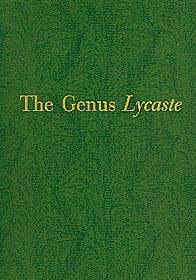
Orchid people with interest in the genus Lycaste will
consult this book one or another day because the author gives an almost
complete description of all (on date of edition in 1970) Lycaste-species.
In the first chapter a number of technical terms are declared, those
that readers of flora and orchid books meet regularly: recessive, dominant,
homo- or heterozygote, phenotype, type, … A good repetition for
those who studied formerly biology, a useful intro for those who didn’t.
In the second chapter is dedicated to culture of the Lycaste-species.
It is indeed impossible to give general rules because those species
live in different en very variable habitats. Usually, Lycaste-species
do not suffer much from pests or diseases but the author gives the readers
some thoughts about this. His gives also some notes about the fertilising
of this plants.
The most important part of this book discusses each Lycaste-species
separately and completely.
For each species, a list of used and relevant literature is given with
a brief account about the name. There is a complete description of the
plant and flowers, the habitat, sometimes an anecdotic story about the
finding of some plants or field trips in correlation with the writing
of this book
At the end, a list of all Lycaste-species is given and most of the synonym
names.
Till today (2004) THE GENUS LYCASTE by J.A. Fowlie is the most complete
work about the genus Lycaste.
But… long experiences with culture of and studies about the Lycaste-species
learn that Fowlie included some important mistakes in his monograph.
One has a bit the impression that pressure from deadline for publication
was more important than more accurate studies.
Dr. H.F. Oakeley from England - a worldwide well known
Lycaste-specialist – did edit a new, up-to-date
monograph of the genus Lycaste. He also is author/editor of ‘Lycaste
species, the Essential Guide’ (1993).
More about Lycaste click here 1 or 2 or 3.
(top)
Wie interesse heeft voor het geslacht Lycaste zal vroeg of laat dit
werk moeten raadplegen. De auteur geeft namelijk een grondige beschrijving
van alle tot dan (1970) gekende Lycaste-soorten.
In het eerste hoofdstuk worden een aantal biologische termen behandeld
die we dikwijls ontmoeten in de literatuur: recessief, dominant, homo-
of heterozygoot, geno- en fenotype, enzovoort... Een goede herhaling
voor wie biologie gestudeerd heeft, een bruikbare inleiding voor wie
dit niet gedaan heeft.
In het tweede hoofdstuk gaat het over de cultuur van de Lycaste-soorten.
Vermits die in verschillende, zeer variërende levensomstandigheden
groeien is het inderdaad onmogelijk om algemene regels te verstrekken.
Lycaste-soorten hebben meestal ziekten noch plagen maar toch geeft de
auteur hieromtrent enkele bedenkingen.
Ook over de bemesting van de Lycaste's heeft J.A. Fowlie enkele opmerkingen.
Het grootste deel van het boek behandelt dan elke Lycaste-soort afzonderlijk
én zeer volledig.
De lezer krijgt een overzicht van de geraadpleegde literatuur met een
korte verantwoording van de juiste naamgeving. Er is een volledige beschrijving
per plant (interessant voor een determinatie), de groeiplaats van die
plant, hier en daar een anekdotisch verhaal over het ontstaan van een
bepaald deel van het boek en een daarmee verband houdende ontdekkingstocht
of zoektocht ergens in de Zuid-Amerikaanse brousse.
Achteraan staat een overzichtelijke, alfabetische lijst van alle Lycaste-soorten
en de meeste synoniemen.
Tot nu toe is THE GENUS LYCASTE van J.A. Fowlie het meest volledige
boek over het geslacht Lycaste. Er is echter een maar… Jarenlange
studie én cultuurervaringen met planten uit dit geslacht leren
dat Fowlie de ‘bal hier en daar serieus mis slaat’. Men
kan zich niet van de indruk ontdoen dat, in de periode die aan het uitgeven
voorafging, het halen van de deadline belangrijker was dan het uitdiepen
van de te publiceren inhoud.
Dr. H.F. Oakeley uit Engeland gaf een nieuwe, up-to-date monografie uit over het geslacht Lycaste. Hij gaf in eigen beheer het boekje 'Lycaste species, the Essential Guide' uit (1993).