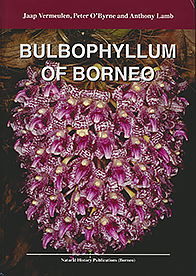
Bulbophyllum of Borneo.
door Jaap Vermeulen, Peter O’Byrne & Anthony Lamb
728 pp., Veel kleurenfoto’s en pentekeningen
Natural History Publications, Kota Kinabalu – Borneo, 2015.
ISBN 978-983-812-156-9
Introduction (p.1-13).
This book, dedicated to Lady Yuen-Peng McNeice (1917-2012), begins with a short situation of the genus Bulbophyllum (page 1-2) and the project ‘Bulbophyllum of Borneo’ (page 2-3) in which the authors explain why they did not go further with the series ‘Orchids of Borneo’ (1986) whose volume 2 was entirely dedicated to Bulbophyllum and in which 100 species were covered. To continue this series with only Bulbophyllum in terms of content, 3 extra volumes would have been necessary. This led the authors to decide that they would work on a review of all Bulbophyllum-species in Borneo: 288 species and subspecies. They are also convinced that not all species are presented in this work because during the preparatory studies they concluded, based on photographs of the flowers, that 5 species are not described yet. Anthony Lamb even claimed 25 years ago that the number of Bulbophyllum-species in Borneo would certainly exceed the 300, in 2015 that was almost the case.
Under the heading ‘Use of this Revision’ (pp. 3-4) we read more about the content of this book: all in Borneo known Bulbophyllum-species, an iconographic representation with the most species with a pen drawing and photographs, a limited number synonym names and the names as mentioned in the literature on the flora of Borneo, names that e.g. explain the synonymy between species that are known for Thailand under a different name, and so on ...
In the subchapter ‘Bulbophyllum Thou’ (pp 4-6) we see a list of genus names by the authors label as sections within the genus Bulbophyllum (eg Cirrhopetalum Lindley = Section Cirrhopetalum, Osyricera Blume = section Brachystachyae, Epicrianthes Blume = section Epicrianthes , Ephippipium Blume = section Ephippipium, and so on ...). The terminology of the flowers is explained with some schematic drawings.
The ‘Key to the Sections of Borneo Bulbophyllum’ brings us through 4 groups (A, B, C and D) to 31 different sections within Bulbophyllum on Borneo.
From p. 15 to p. 708 all sections and the species and subspecies within these sections are extensively discussed: the species name and a limited number of synonyms with reference to the bibliography, the description of both plant and flowers, the habitat, the distribution on Borneo and where applicable elsewhere in Southeast Asia. Some extra information is briefly added to some species. Very beautiful, detailed pen drawings illustrate most species and a nice photo is published with the discussion of the species; for some species even more than one photo.
The book concludes with ‘References’ (pages 709-717): a very extensive reference to relevant literature; ‘Acknowledgements’ you (p.718) and an ‘Index of scientific names’ mentioned in this work.
Conclusion.
This nicely published monograph is a completion of all that Vermeulen and C ° have published about the genus Bulbophyllum. It was, I think, not the intention of the authors to indicate how Bulbophyllum species are best grown. As they write in the introduction, this book is a review (revision) of the genus Bulbophyllum. I assume that this book will be useful not only for Bulbophyllum amateurs and for scientists. The photos and pen drawings are beautiful and are, together with the texts, useful for determination. That the photos are grouped nearby the description of each species and the drawings is a very worthy surplus.
top
Introductie (p. 1-13).
Dit boek, opgedragen aan Lady Yuen-Peng McNeice (1917-2012) start met uitleg over het geslacht Bulbophyllum (p. 1-2) en het project ‘Bulbophyllum of Borneo’ (p. 2-3) waarin de auteurs verduidelijken waarom ze niet verder gingen met de serie ‘Orchids of Borneo’ (1986) waarvan het volume 2 volledig aan Bulbophyllum gewijd was en waarin 100 soorten aan bod kwamen. Om deze serie verder te zetten met inhoudelijk alleen Bulbophyllum zouden nog 3 extra volumes nodig geweest zijn. Dit deed de auteurs besluiten dat ze aan een herziening zouden werken van alle Bulbophyllum-soorten op Borneo: 288 soorten en ondersoorten. Ze zijn er ook van overtuigd dat in dit werk niet alle soorten aan bod komen want tijdens hun voorbereidende studies stelden ze aan de hand van foto’s van de bloemen vast dat zeker 5 soorten nog niet beschreven zijn. Anthony Lamb beweerde 25 jaar geleden zelfs dat het aantal Bulbophyllum-soorten op Borneo zeker de 300 zou overschrijden, in 2015 was dat bijna het geval.
Onder de hoofding ‘Use of this Revision’ (p. 3-4) lezen we wat in dit boek aan bod komt: alle op Borneo gekende Bulbophyllum-soorten, een iconografische voorstelling met de meeste soorten evenals een pentekening en foto’s, een beperkt aantal synoniemnamen en de namen zoals vermeld in de literatuur over de flora van Borneo, namen die bv. de synonymie verklaren tussen soorten die voor Thailand onder een andere naam gekend zijn, enzovoort…
In het subhoofdstuk ‘Bulbophyllum Thou’ (p. 4-6) zien we een lijst met geslachtsnamen die de auteurs als secties binnen het geslacht Bulbophyllum bestempelen (bv. Cirrhopetalum Lindley = Sectie Cirrhopetalum, Osyricera Blume = sectie Brachystachyae, Epicrianthes Blume = sectie Epicrianthes, Ephippipium Blume = sectie Ephippipium, enzovoort…). Aan de hand van enkele schematekeningen wordt de terminologie van de bloemen uitgelegd.
De ‘Key to the Sections of Borneo Bulbophyllum’ brengt ons via 4 groepen (A, B, C en D) tot de 31 verschillende secties binnen Bulbophyllum op Borneo.
Vanaf p. 15 tot en met p. 708 worden alle secties en de soorten en ondersoorten (subspecies) binnen die secties uitgebreid besproken: de soortnaam en een beperkt aantal synoniemen met verwijzing naar de bibliografie, de beschrijving van zowel plant als bloemen, de habitat, de verspreiding op Borneo en waar van toepassing elders in Zuidoost-Azië. Bij sommige soorten wordt kort nog wat extra info meegegeven. Zeer mooie, gedetailleerde pentekeningen illustreren de meeste soorten en bij de bespreking van de soorten staat een mooie foto gepubliceerd; bij enkele soorten meer dan één foto.
Het boek sluit af met ‘References’ (p. 709-717): een zeer uitgebreide verwijzing naar relevante literatuur; bedankingen (p. 718) en een index van de in dit werk aan bod komende wetenschappelijke namen.
Conclusie.
Deze mooi uitgegeven monografie is een vervollediging van alles wat Vermeulen en C° al publiceerden over het geslacht Bulbophyllum. Het was, denk ik, niet de intentie van de auteurs om mee te geven hoe Bulbophyllum-soorten best gekweekt worden. Zoals ze zelf in hun introductie meegeven is het een herziening (revisie) van het geslacht Bulbophyllum. Ik ga ervan uit dat dit boek van nut zal zijn niet alleen voor Bulbophyllum-liefhebbers maar zeker ook voor wetenschappers. De foto’s en pentekeningen zijn prachtig én samen met de tekst bruikbaar voor determinatie. Dat de foto’s naast de beschrijving van elke soort staan en de tekeningen gegroepeerd naast of slechts enkele pagina’s verwijderd van die beschrijving is een zeer te waarderen pluspunt.
top